DP World has set out its ambition to increase the proportion of containers moved by rail at Southampton from 30% to 40% by 2026. The operator says its ongoing investment in rail services and inland connectivity will be key to meeting that target, part of its wider drive to decarbonise supply chains.
The company is already celebrating success with its Modal Shift Programme, which in its first year removed more than 64,000 lorry journeys from UK roads. Central to that achievement has been the strengthening of intermodal services at Southampton and the expansion of an intermodal inter-port rail link with London Gateway, DP World’s other UK property.
Targeting trains for modal shift
Southampton is already Britain’s leading deep-sea port for container rail traffic, handling more than thirty per cent of all imported laden containers by train. DP World wants to push that further, setting a new target of forty per cent by 2026. Meeting the goal will mean hundreds of thousands more containers moving inland by rail instead of road, reducing congestion around the port and removing millions of road miles annually.
According to DP World, the growth in rail share at Southampton has already been transformative. A decade ago, just over one in five boxes travelled inland by train. Today, more than three in ten do. The new target represents not just a technical ambition but a statement of intent, signalling the company’s commitment to sustainable logistics in the UK.
More London Gateway–Southampton rail links
A high-profile part of this effort is the inter-port intermodal service connecting Southampton with DP World’s London Gateway hub. Launched as a weekend-only operation, it has now been expanded to run twice weekly, with Freightliner introducing a new mid-week service from 1 October 2024. The additional working doubles capacity between the two ports, creating new options for shippers and strengthening resilience in the face of supply chain disruption.
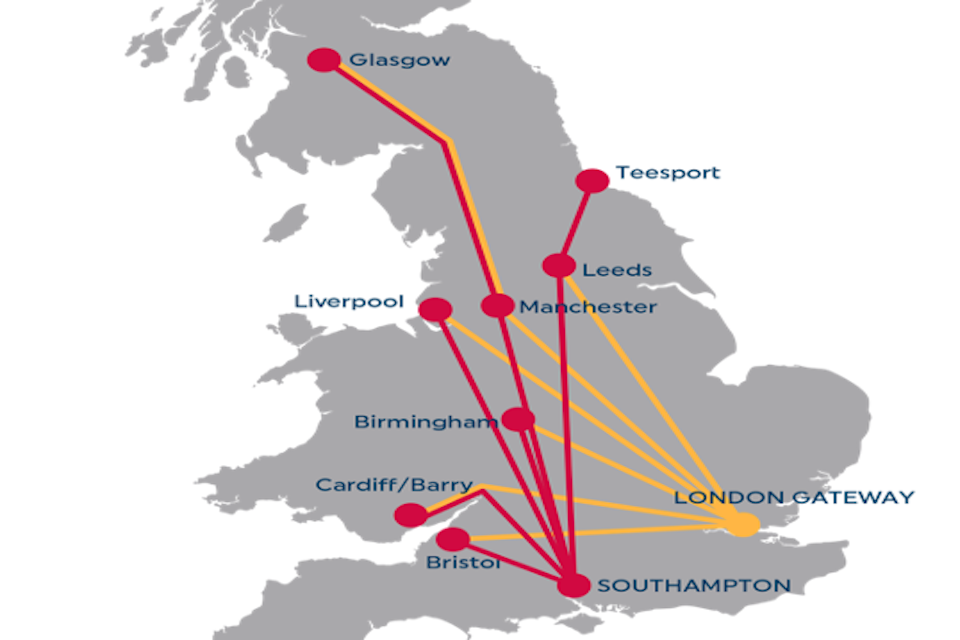
By shifting containers between ports on rail rather than road, DP World is cutting carbon emissions while providing operational flexibility for customers. Cargo can be landed at Southampton and seamlessly transferred to London Gateway’s logistics park, the largest of its kind in the UK. The inter-port link is now seen as a testbed for wider intermodal innovation, directly supporting the modal shift agenda.
Carbon savings and supply chain resilience
DP World says its Modal Shift Programme, under which the Southampton–London Gateway link sits, is already delivering measurable benefits. More than 64,000 lorry trips have been eliminated in the past year, saving around one million road miles. The additional mid-week service is expected to compound those gains, ensuring capacity is available when demand peaks.
The inter-port shuttle also helps reduce the risk of congestion at either hub. Containers that may otherwise have been delayed can be transferred and processed at the alternate site, keeping cargo moving and reducing bottlenecks. This kind of operational flexibility is becoming more critical as global supply chains face ever more frequent shocks.
Capacity enhancements down the line
DP World is not only focused on services. At London Gateway, the company has committed more than £1 billion (€1.18bn) in expansion projects, including the construction of a second rail terminal to support growing volumes (as reported by WorldCargoNews.com, our sister service for maritime affairs and trade). The Southampton–London Gateway shuttle is expected to play a part in feeding that new facility, once operational.
The investment underlines DP World’s belief in rail as a core element of its UK offer. By 2026, with the Southampton target achieved and London Gateway’s capacity increased, the company expects to have significantly boosted its share of rail-connected cargo. For an industry under pressure to deliver on decarbonisation, that shift would mark a step change in how Britain’s containerised freight is moved.
Shifting containers in 2026 and beyond
The forty per cent by rail goal at Southampton is ambitious. DP World argues, however, that it is both realistic and necessary. The port operator notes that rail has become central to its operations and that it intends to deepen that commitment by investing in capacity, services, and innovation to deliver greener, more resilient supply chains.
With inter-port rail now firmly established and major investments underway, DP World appears confident that the coming years will deliver a modal shift at scale. That ticks all the boxes for the UK government’s net-zero ambitions too. If Southampton reaches the forty per cent benchmark, it will not only confirm the port’s status as the UK’s leading rail-connected terminal but also set a template for modal share growth across the wider network.