The Waterloo Freight Hub Trial is a pilot project repurposing underutilised space beneath London’s Waterloo Station. The scheme has been operating for two months and is showing encouraging results for sustainable urban logistics. Similar light logistics innovations are also coming down the tracks or have already arrived at other London termini.
The plan to bring light logistics back to one of London’s most famous stations has been led by Cross River Partnership. The CRP describes itself as a test bed for designing and delivering innovative pilot projects to improve London life. At Waterloo, they are working with partners including Network Rail, Lambeth Council, the Department for Transport, London and Continental Railways, and local management at Waterloo. The six-month trial is testing the feasibility of a zero-emission last-mile logistics model based at a major passenger station.
A series of studies
Since March this year (2025), logistics provider Delivery Mates has been delivering parcels by van into the undercroft of Waterloo Station, before transferring them onto a fleet of ten electrically assisted cargo bikes for final distribution across central London. The project is designed to reduce road congestion, lower air pollution, and support the growth of green jobs in the capital.

The initiative is funded by the Department for Environment, Food & Rural Affairs, a UK government agency. Defra’s Smarter Greener Logistics programme and managed by Westminster City Council and CRP’s Ross Phillips. It follows a series of studies over the past four years, including Network Rail’s survey into logistics potential at major stations, and the 2022 “On Track for Sustainable Logistics” feasibility report by the CRP.
A permanent hub at Waterloo
Waterloo was identified as an optimal location for urban freight due to its extensive undercroft space, previously used for Eurostar operations before services moved to St Pancras in 2007. The current trial marks the first operational step toward a long-term vision for a full-scale “Multi-Modal Waterloo Freight Hub” capable of handling middle-mile deliveries by road, rail and river.
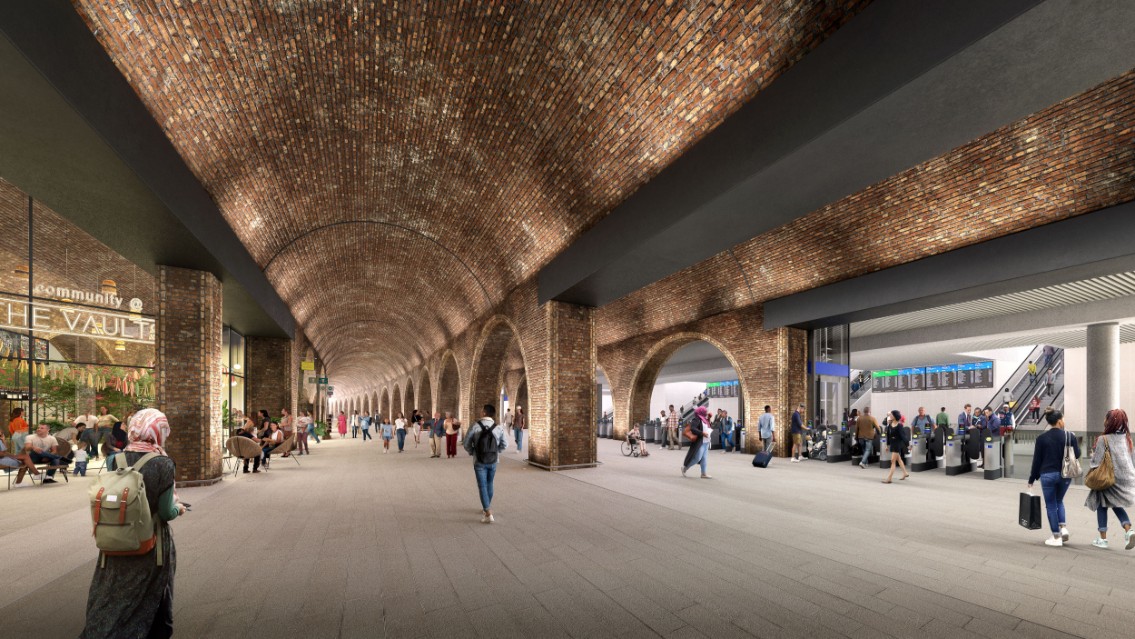
“Transforming existing station infrastructure for freight provides a significant opportunity to decarbonise deliveries into London,” said Ross Phillips, CRP’s Sustainable Transport Manager. “A permanent hub at Waterloo could future-proof the capital’s logistics network as commerce volumes continue to grow.”
From vans to trains
Using rail for light logistics has been a desire for a number of commercial operations. Notably, InterCity RailFreight, which came to the public attention during the Covid pandemic for keeping medical supplies moving, and Varamis Rail, the general cargo operator who recently announced plans to extend operations to Liverpool Street. For their part, Cross River Partnership is currently gathering data from the trial and engaging with potential funders, policymakers and logistics providers to explore a permanent installation.
While the current trial is road-fed, future plans aim to bring freight directly into Waterloo by rail, creating one of the first urban logistics hubs of its kind within a major passenger station in the UK. Despite the trial’s success so far, challenges remain, particularly around funding, regulatory approvals, and the technical requirements to reinstate freight handling capability at an active station. However, the Waterloo Freight Hub project is seen as a potential model for sustainable freight operations across the country.