Between the port of Antwerp and the Ruhr industrial region, there lies an old defunct freight railway. Its reactivation could speed up transportation and could be beneficial for military mobility. Yet, a minor but crucial stakeholder could prove to be an obstacle to the “Iron Rhine”.
Flemish mobility minister Annick de Ridder seems enthusiastic about the idea. “It is evident that I will use every opportunity to discuss the Iron Rhine file with the relevant partners”, she told Belgian media earlier this year.
She is not the first person in Belgium to bring up the Iron Rhine. In recent times, glass producer Ciner Glass, which is building a new production facility along the old railway, proposed reopening the railway and an old intermodal terminal in the vicinity. It would have great logistical benefits for the company and the industrial zone surrounding its new plant.
Rail freight in Lommel
Ciner Glass’s proposal to restart rail freight along the Iron Rhine in Lommel entails 175 annual trains servicing the site. Each would take 50 trucks off the road – a major congestion relief operations and good for the environment. The glass manufacturer alone expects to use a hundred trucks per day when its factory is finished in 2026.
With direct connections to the Antwerp port and the Ruhr region, it looks like a great deal, reactivating the line. But Belgium’s northern neighbour, the Netherlands, also has a say in the matter. It just so happens to be that a short section of the line crosses the southern part of the country, so it would need to agree and cooperate on a potential reopening.
Costs and benefits
And it is not stoked about that idea. In the past, the Hague has said that a nature reserve along the railway makes traffic impossible. That could be a legitimate part of the Dutch concerns, but there seems to be more at play.
The Dutch ministry of infrastructure explains to RailFreight.com that the cost-benefit analysis for the Netherlands does not check out. “We want to look at all options for cross-border connection between the Netherlands, Belgium and Germany together. That concerns 3RX [Iron Rhine], but also other new cross-border infrastructure projects that bring benefit to the entire region”, the ministry says.
“It is important to involve all countries well, because this really is a trilateral story, despite the very negative societal cost-benefit analysis for the Netherlands. By that, we mean that the Netherlands would mostly carry the burden of the connection and not get the advantages”, the ministry continues. It is looking for a win-win-win scenario.
Port competition
Even if they do not explicitly say it, the Dutch concerns seem to be related to the port of Rotterdam. A better connection to the port of Antwerp would give Rotterdam’s Belgian counterpart a competitive advantage – something the Dutch probably want to avoid, Belgian rail journalist Herman Welter told SpoorPro.

Image: © Port of Antwerp
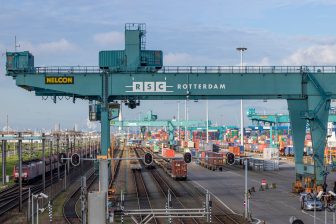
Image: Shutterstock. © Edwin Muller Photography
Besides that, both Belgium and the Netherlands are spending most of the rail budget on completely different projects, such as ERTMS and TEN-T corridors. Two billion Dutch euros will be spent on the Lower Saxony line in the north – which the country moved from another rail project’s budget. Money is tight.
The Belgian mobility minister is making an effort by putting the Iron Rhine on the agenda, but it seems unlikely that it will make a return. There are not enough financial resources, and the ever-present struggle of national thinking in European rail throws a spanner in the works of its advocates.
The first, second and third Iron Rhines
Between 1879 and 1914, the Iron Rhine served mainly as a freight line between the port of Antwerp, the Mönchengladbach transport hub and the Ruhr region. The railway ran from Antwerp via Lommel to Hamont, where it crossed the border with the Netherlands. From there, the line led to Germany via Budel, Weert and Roermond. This was, in fact, the “second” Iron Rhine, as the “first” had been running from Antwerp via Leuven, Liège and Aachen to Cologne since 1843.
At the outbreak of the First World War, the neutral Netherlands closed the second Iron Rhine at the border, as it was not allowed to allow transports between Germany and occupied Belgium. Germany, replacing the first and second Iron Rhine, built a third one: the Montzen route. It runs between the port of Antwerp and Aachen in Germany, via Aarschot, Hasselt and Tongres and Aachen, making it 50 kilometres longer than the “second” Iron Rhine, but bypassing the Netherlands.
The Montzen route has also been fully electrified since 2008 and is still in use anno 2025. In April 2022, the European Commission’s Directorate-General for Mobility and Transport announced that Infrabel would receive five million euros from the “EU Military Mobility Fund” for the construction of four long tracks in the Montzen formation bundle to allow 740-metre trains to run between the port of Antwerp and the German border.