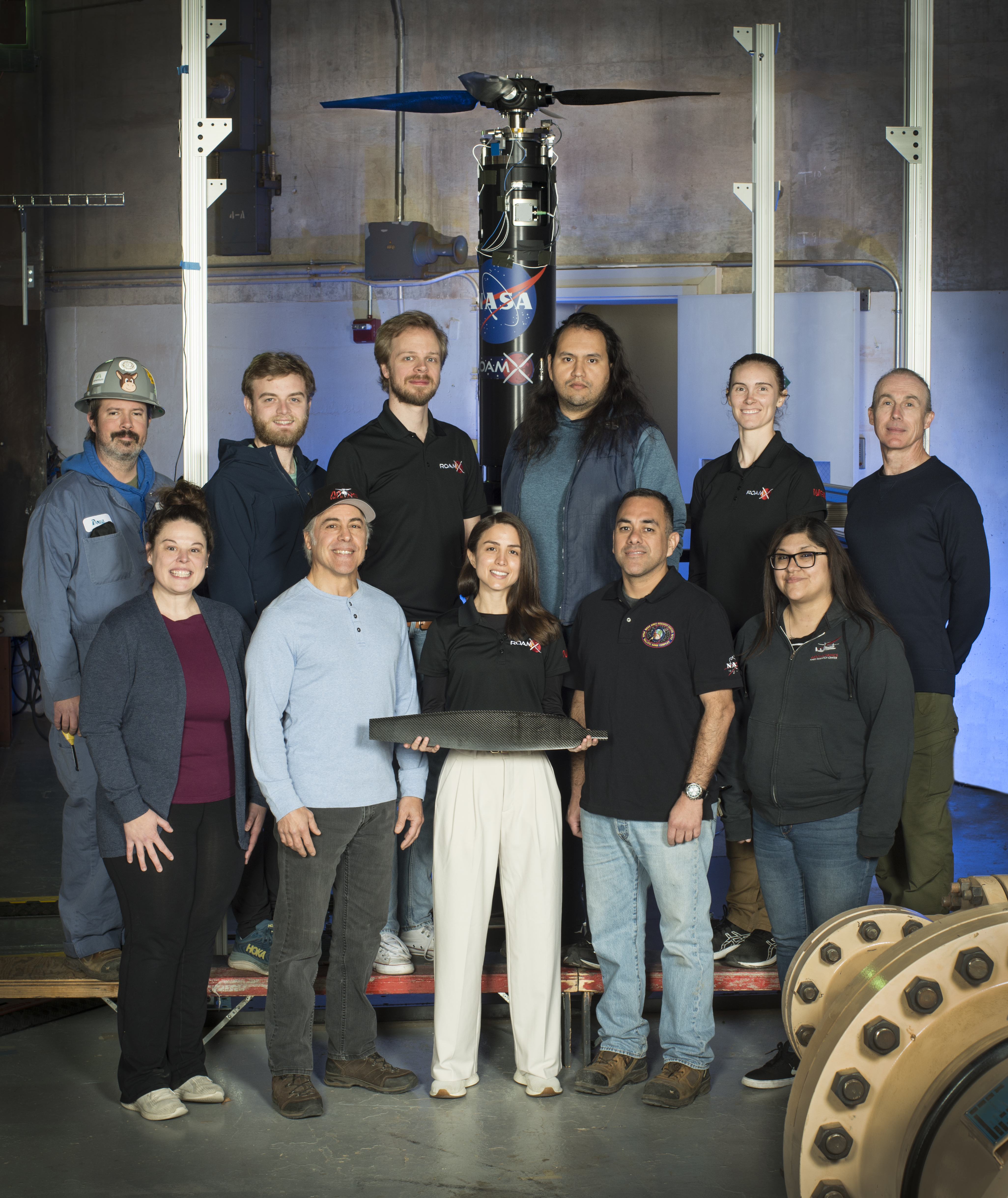
During 2024-2025, helicopter blades optimized for Mars were tested in the Planetary Aeolian Laboratory (PAL) at NASA Ames Research Center as part of the Rotor Optimization for the Advancement of Mars eXploration (ROAMX) project. The experimental test-chamber of the PAL can be depressurized to create atmospheric air pressures of different planetary bodies such as Mars. The full-scale ROAMX blades were spun in hover configuration up to 4000 RPM at an atmospheric density of Mars (approximately 0.015 kilograms per cubic meter). The Ingenuity blades were also tested in the PAL to compare the performance of the optimized blades against the Ingenuity Mars Helicopter Technology Demonstrator. The test was conducted to validate computational models of the performance of the optimized blades. Simulations show that the optimized ROAMX blades perform significantly better than the Ingenuity blades, allowing helicopters on Mars to fly farther, faster, and carry a science payload. The next phase of testing will occur with higher RPMs and additional collective angles.
Related Posts
Tuning a NASA Instrument: Calibrating MASTER
- Brian Evans
- June 12, 2025
- 0
NASA’s Ames Research Center in Silicon Valley houses a unique laboratory: the Airborne Sensor Facility (ASF). The engineers at the ASF are responsible for building, maintaining, and operating numerous instruments that get deployed on research aircraft, but one of their most important roles is instrument calibration. Think of calibration like tuning a piano between performances: […]
NASA Drop Test Supports Safer Air Taxi Design and Certification
- Brian Evans
- July 29, 2025
- 0
As the aviation industry works to develop new air taxis and other electric aircraft made from innovative, lightweight materials, there’s a growing need to understand how those materials behave under impact. That’s why NASA is investigating potential air taxi materials and designs that could best protect passengers in the event of a crash. On June […]
- Advanced Air Vehicles Program
- Aeronautics
- Aeronautics Research Mission Directorate
- Ames Research Center
- Armstrong Flight Research Center
- Commercial Supersonic Technology
- Glenn Research Center
- Integrated Aviation Systems Program
- Langley Research Center
- Low Boom Flight Demonstrator
- Quesst (X-59)
- Quesst: The Vehicle
- Supersonic Flight
NASA X-59’s Latest Testing Milestone: Simulating Flight from the Ground
- Brian Evans
- May 16, 2025
- 0
NASA’s X-59 quiet supersonic research aircraft successfully completed a critical series of tests in which the airplane was put through its paces for cruising high above the California desert – all without ever leaving the ground. “The idea behind these tests is to command the airplane’s subsystems and flight computer to function as if it […]

