In Britain, opportunities exist for modal shift to rail. That will come as no surprise. None of the attendees in London at the Demystifying Rail Freight workshop were surprised by that statement. They were not quite that new to the concept. However, the mechanics of getting freight onto rail was the topic of the day, and that was more of an enlightenment.
It was organised as a fact-finding mission for potential customers. Demystifying Rail Freight was promoted by Logistics UK, the largest trade body in the sector. The hosts were Great British Railways Transition Team (GBRTT) at their London offices within Waterloo Station. GBRTT has been set up by the UK government to manage the transfer of the railway network to public ownership. It’s also there to help realise the mandated growth in the rail freight sector.
Venue historically appropriate
A forum for the uninitiated at Waterloo. One of London’s (and Britain’s) busiest passenger stations may not seem the intuitive venue for a discussion about rail freight. However, in retrospect, the freight heritage at Waterloo makes that vast passenger terminal entirely appropriate.
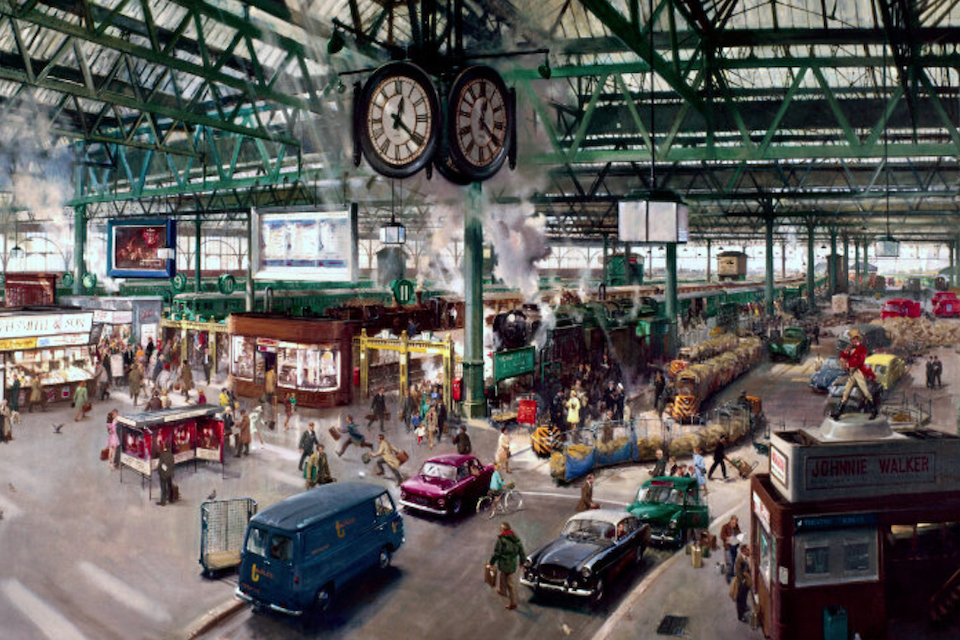
Over the years, Waterloo has frequently been Britain’s busiest passenger station. However, it has also handled vast quantities of light logistics and parcels on its 24 platforms. In common with many of London’s major stations, vaults exist below the tracks for short-term storage and last-mile forwarding, typically of perishable goods. Ironically, that traffic has been largely given up, and much of that estate has been repurposed. However, a survey was undertaken by Network Rail, identifying that reintroducing modern logistics to major stations was viable.
Low baseline, high potential
Opening remarks by Guy Bates, the Head of Freight Development at Network Rail, reiterated that rail freight has a tiny proportion of overall freight movements. By most metrics, rail commands only about ten per cent of the market. His address emphasised that opportunities for rapid growth exist. The low baseline makes even a modest modal shift towards rail a radical improvement in the sector.

Certainly, the myths were demystified. The story of one trader in Asian foods from the north of England was quoted. Their produce generates one container per month, sent to market by rail. It made the point that using rail freight does not require customers to own a train. “We’re not all the poster child of rail freight,” opined one attendee, referring to the supermarket chain Tesco, which dispatches multiple branded intermodal trains daily.
Six million containers
“I think there are preconceptions that people bring,” said Jonathan Walker of Logistics UK. The expectation that rail freight is expensive, slow and unreliable is held by those who have not engaged with the industry. Conversations like those at the workshop in Waterloo prove otherwise, and although it was a self-selecting group, it has yielded a new cohort of advocates for the rail freight industry.”
Steve Freeman, co-founder of RailX, a self-confessed “Booking dot com for containers with a wunderlust” pointed out that British ports land six million containers every year. “Ninety per cent of these imported containers are delivered by road,” he said. “Only ten per cent by rail, [for a] value to Rail around £1.4bn.” That’s a missed opportunity, he said, to take a larger slice of the remaining £12.1bn. That’s quite a lot of asian food containers.