Alstom is expanding an energy-saving programme across its UK maintenance facilities after cutting recorded natural gas consumption by more than a third at two London railway depots.
The initiative supports Alstom’s wider global contribution to more sustainable mobility. Every day, 108 million people travel on Alstom trains, while greenhouse gas emissions from the company’s own operations and energy use are now 52% below the relevant baseline.
At Alstom’s Golders Green and Morden Traincare Centres, targeted, smart engineering improvements are helping reduce unnecessary energy use by automatically connecting depot doors with heating systems.
A purpose-built, hard-wired interlocking system ensures the heating responds automatically to depot operations, switching off as soon as the large train-access doors open and only resuming once they are fully closed. Designed with depot teams, controlled overrides build adaptability into the solution, allowing it to respond to changing operational needs while minimising energy use.
At Golders Green, recorded gas consumption during the 2024/25 winter was around 30% below its 2022/23 baseline. In 2025/26 it remained around 33% below that baseline, delivering two successive winters of significantly lower recorded gas use following installation in early 2024.
Alstom introduced the same approach at Morden in 2025. In its first winter following installation, recorded gas consumption was approximately 37% below the 2022/23 baseline, falling from 1.99 GWh to 1.26 Gwh.
Across the winter periods measured at both sites, recorded gas consumption was approximately 3.24 GWh below the corresponding 2022/23 baselines. This equates to around 657 tonnes of carbon dioxide equivalent (CO₂e) in lower associated emissions – comparable to the electricity consumed by more than 425 average households for an entire year.
“The results at Golders Green and Morden show what practical engineering can achieve. By targeting a specific source of wasted energy, we are delivering significant and sustained reductions in gas consumption without waiting for major infrastructure replacement,” said Utkarsh Singh, professional head of environment UK at Alstom.
He added: “Our ambition now is to build on what works. As the country’s number one rail services provider, we want measures like these to make a positive contribution across our entire UK footprint.”
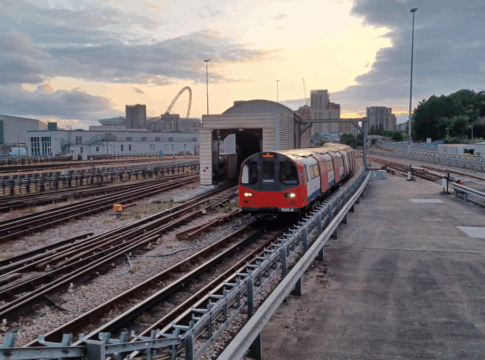
Golders Green and Morden Traincare Centres are vital parts of London Underground’s Northern line, where Alstom maintains the fleet of 106 1995 Stock trains. The Alstom-built fleet entered passenger service in 1998 and continues to serve millions of Londoners and visitors each year.
The historic maintenance buildings at Golders Green and Morden are around 180 metres long, with high ceilings, multiple tracks and large access doors that open regularly, including during the coldest months. Linking those doors to the heating controls prevents valuable heat being generated while they are open.
Wembley Traincare Centre is planned as the next location in Alstom’s gas reduction programme by the end of the year, with further sites expected to follow in 2027. Performance will continue to be monitored as the technology is deployed under different operating conditions.
From local action to global impact
The programme forms part of Alstom’s wider work to reduce the environmental impact of its operations. Globally, greenhouse gas emissions from Alstom’s own operations and energy use stood at 110.9 ktCO₂e in 2025/26, 52% below the relevant baseline, while 100% of its activities are powered by renewable electricity.
Alstom’s science-based targets include a 40% absolute reduction in Scope 1 and 2 greenhouse gas emissions by 2030 from a 2021/22 baseline, alongside its ambition to achieve net-zero emissions by 2050. In the UK, this ambition is reflected in measures ranging from manufacturing Britain’s first mainline battery-electric trains to engineering out wasted energy at existing maintenance facilities.
The gas interlocking programme demonstrates how targeted improvements, intelligent controls and the knowledge of depot teams can make existing railway infrastructure more energy efficient while delivering measurable reductions today.
As COP31 – taking place in Antalya, Türkiye from 9 to 20 November 2026 – focuses attention on implementing climate commitments, the results from Golders Green and Morden offer a practical example of global ambition being translated into action at individual sites.
Image credit: Alstom