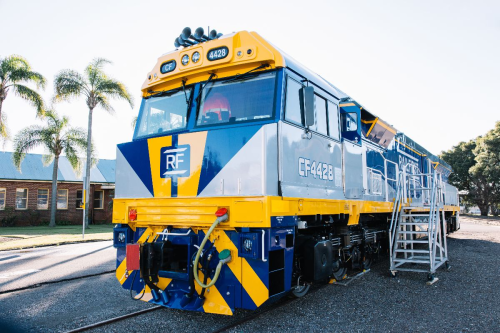
The Australian Rail Track Corporation (ARTC) officially switched off the last two of seven out-dated regional radio systems previously used on its network today, completing a seven year project.
“The ‘switch off’ of the old radio systems in NSW and Victoria means freight trains operating on ARTC’s national freight rail network now use a single, safer, digital radio system,” ARTC CEO John Fullerton said.
“In saying goodbye to analogue radio we can clearly see one the reasons why ARTC was established – to drive a co-ordinated and planned approach to investment across the national rail freight network to make it simpler and easier for customers to use,” Mr Fullerton said.
“The implementation of the digital, 3G-based National Train Communications System (NTCS) project, in close cooperation with Telstra, provides a single, digital backbone to ARTC communications, a true national communications network interoperable with systems across the nation.”
The NTCS project started in 2007 and leverages the Telstra NextG™ mobile network – it provides 100 per cent coverage with the assistance of satellite communications. The project was funded by the Australian Government.
While the physical network including mobile communications towers and satellites has been in place since June 2010, the retrofitting and testing of ICE (In-cab Communications Equipment) units across the national locomotive fleet and multiple operators has now been completed.
Currently 900 trains with ICE units operate across the country, 704 units were supplied by ARTC as part of the NTCS project.
“Despite this being a complex task with multiple stakeholders, it is a testament to the cooperation and close working relationship of the rail industry that we see the final step taken today to solely switch to digital,” Mr Fullerton said.
The ICE units mean no more double handling of radio equipment for train drivers using the Defined Interstate Rail Network.
“This is another sign of the national freight network?s ongoing modernisation and standardisation – making it far easier to use as a mode and reinforcing our competitiveness and reliability.
“Not only does ICE provide a single interface for train drivers right across the interstate network, ARTC saves costs by no longer needing to operate multiple communications platforms,” said Mr Fullerton.
The NTCS solution also provides a reliable, high speed data network to support existing and future data intensive applications.
“In addition to being a safer communications platform by removing previous coverage blackspots, NTCS has provided a platform for ARTC to innovate and take advantage of the possibilities that come with a digital network,” Mr Fullerton said.
Using the Telstra NextG™, applications such as safe travelling distance technology (proximity alerting), real-time locomotive tracking, sophisticated track and wayside monitoring technology, track awareness support systems and the next generation of ARTC freight management, the Advanced Train Management System (ATMS) have all been able to be tested.
V/Line relies on the Australian Rail Track Corporation (ARTC) because it operates the National Train Communications System (NTCS). This network provides the essential, safety-critical data and voice links required for regional trains to communicate with control centres and trackside workers.
If that is so all railway and telco should be return to public hands….
As they are there to run a service not make profit…..
Why on earth do they only rely on ONE telco provider?
The should two incase one goes out due some seemly fat fingered DI engineer botched up the update and that seemly DI twit who signed off the update!
One possibility is the network for V/Line should be using MMR the digital state based network which is high availability because it uses radio technology that is high availability. It was a major mistake to use the NTCS as it is based on a platform that will never be 100% available.