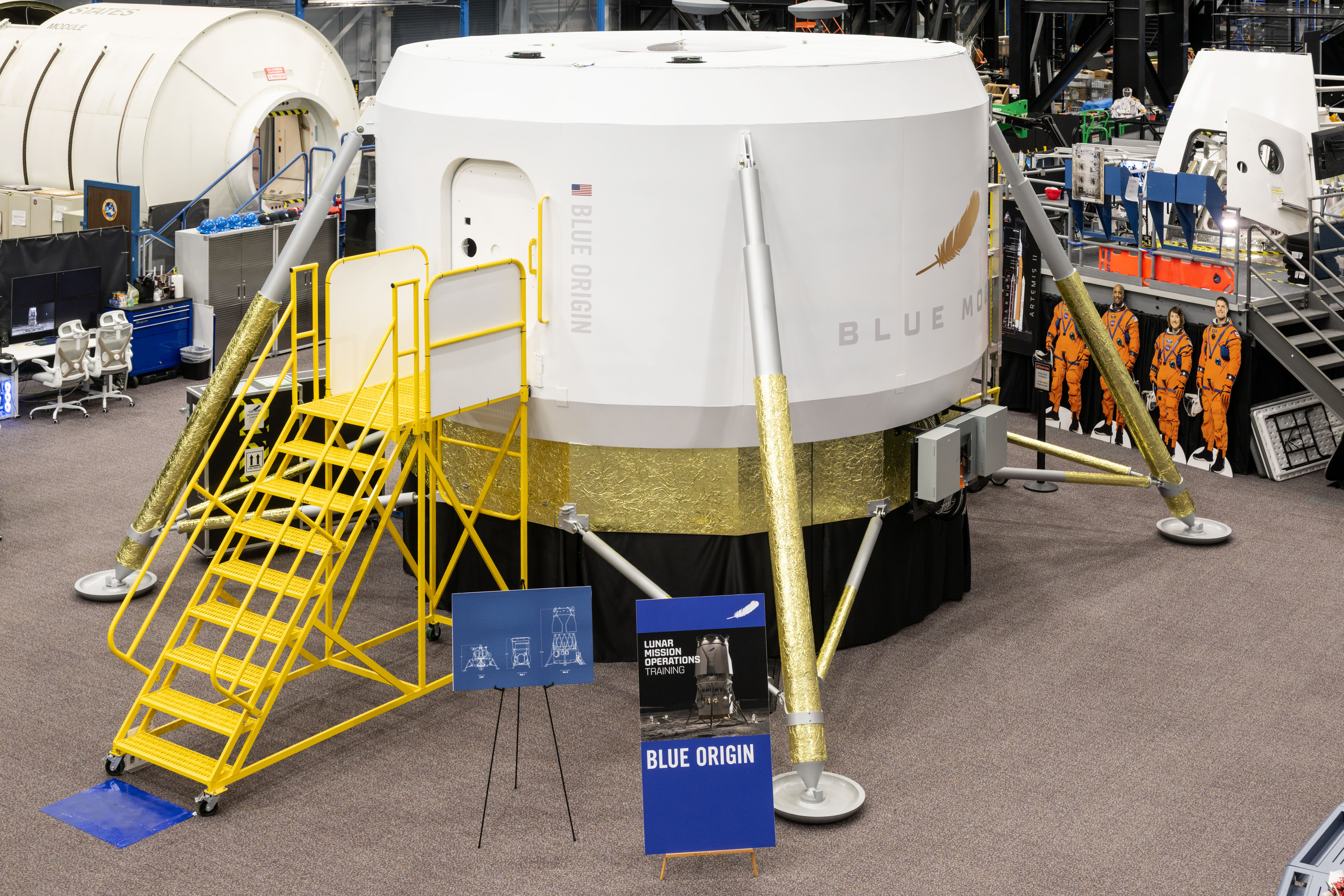
A full-scale mock-up of a crew cabin for a future industry lunar lander for NASA’s Artemis program now is operational for training and testing. The agency and its industry partners will use Blue Origin’s Blue Moon Mark 2 crew cabin for mission simulations as the agency prepares to dock with landers in Earth orbit in 2027 and send astronauts to the Moon by 2028.
NASA is working with two American companies to develop the human landing systems that will safely transport astronauts from lunar orbit to the Moon’s surface and back for Artemis. Blue Origin’s lander, launching uncrewed on top of the company’s New Glenn rocket, will meet astronauts aboard NASA’s Orion spacecraft in lunar orbit. Two astronauts will board the Blue Moon crew lander, which will ferry them to the surface and back to other crew members aboard Orion in lunar orbit following the conclusion of their surface stay.
The Blue Moon crew lander that will fly to the Moon will stand about 52 feet tall. Its crew cabin, located at the base of the lander, will be the living and working space where two astronauts will eat, sleep, conduct science, and observe the lunar environment during their stay.
The prototype at NASA’s Johnson Space Center in Houston is a full-size model, featuring the exterior ladder astronauts will use during their time on the Moon. As NASA and industry teams prepare for future crewed missions to the lunar surface, this model will evolve to support more advanced mission and training needs. Over time, it will become an integrated simulator with interactive systems that help astronauts practice for their flight with ground flight control teams.
NASA and Blue Origin can access the exterior and interior of the crew cabin trainer to conduct a series of human-in-the-loop tests, or tests with human interaction, including mission scenarios, mission control communications, spacesuit checkouts, and preparations for simulated moonwalks. The training cabin will also be used to provide design feedback to the Blue Origin team as the lander continues to be developed and mission planning evolves.
Following the successful Artemis II test flight that took four astronauts around the Moon, NASA will launch the Artemis III mission next year to test critical systems in Earth orbit, including rendezvous and docking with one or both commercial landers from Blue Origin and SpaceX. The agency and its partners will conduct integrated checkouts of life support, communications, propulsion, and potentially new spacesuits. These operations will pave the way for Artemis IV and V in 2028, which will return NASA astronauts to the Moon using these commercial provide landers.
Under Artemis, NASA will send astronauts on increasingly difficult missions to explore more of the Moon for scientific discovery and economic benefits, building the foundation for the first crewed missions to Mars.
Learn more about the Artemis program: