It is a truth, uncomfortably acknowledged, that any chief executive with a grasp of rail freight economics, must be in want of a lower electricity bill. There is no pride, nor any prejudice taken, in the universal knowledge that the railways are not immune to the pressures facing British industry. Feeling the pressure himself is RailFreight.com UK Editor Simon Walton.
If you ask anyone in an energy-intensive sector, they will wring their hands in despair, and simply say one thing: “electricity”. The bad news is that railways are an energy-intensive business most people take for granted, and rail freight is the most energy-intensive of them all.
Expensively installed, too expensive to use
There is no excuse needed for returning to the subject of energy prices – and electricity in particular. Unaffordable electricity casts doubt on the whole point of measures such as strengthening the supply infrastructure on the northern section of the East Coast Main Line. As it stands, there are circumstances where bi-mode electric trains are required to run on diesel, because the fuses will blow on the lineside to Edinburgh – and that’s just passenger traffic demand.

Where does that leave ambitions for multiple multimodal trains, running north of Newcastle, potentially relieving one of the most notoriously under-resourced stretches of highway in Great Britain, the emblematically named A1 – still often known as the Great North Road. What’s the point, though, if those additional trains are hauled by diesels because the expensively facilitated electricity is too expensive to use?
This is no scaremongering – it has already happened. It seems like only yesterday – it was in fact almost exactly four years ago – when electricity costs forced Freightliner to temporarily ground its fleet of former express passenger electric locomotives. What felt then like a shocking rise in electricity prices (over two hundred per cent in a matter of months) has become the norm in the UK. The ratchet has never wound back.
Innovative operators invest innovatively
Why then, might we ask, have operators in Britain invested in new electric locomotives, new bi-mode locomotives and, in the case of one operator, a radical tri-mode class that’s so versatile, it’s a wonder they don’t harness up a couple of strapping big Suffolk Punch horses and call it “quad-mode”. The answer is that, environmentally at least, rail freight still makes sense.
Since those dark days of the Electricity Shock, as no one actually called it at the time, the costs of all forms of freight transport fuel have risen. Those class 90 locomotives may well have returned to the rails, but as surely as sticking your fingers across the plug sockets, the bill delivers a huge shock.
The scenario of using fossil fuel motive power because the base energy is cheaper has met with derision from environmentalists. Yet, while headlines have fixated on soaring electricity prices, the reality for operators is more nuanced.

Electrified freight, like DRS’s new Daventry–Coatbridge service launched last week (see earlier reporting), does draw from the National Grid, so, yes, rising wholesale prices do bite. But freight operators have tools that the rest of the industry often lacks. Long-term supply contracts and hedging can buffer short-term spikes, while operational flexibility allows trains to run when conditions are favourable.
Still making a margin
Diesel remains a fallback, and dual-mode locomotives like DRS’s Class 88 can switch seamlessly, keeping the wheels turning regardless of the electricity market mood. Well, maybe the market doesn’t move quite that fast, but the point is made. It’s no coincidence that operators like DB Cargo (and, yes, Freightliner) are leading the way in adopting alternatives that can be poured straight into the fuel tank. No need for any of that ephemeral electricity stuff at all.
The comparison with heavy industry is instructive. Steel, aluminium, and chemicals are locked into enormous, continuous electricity consumption, leaving them brutally exposed to price swings. Rail, by contrast, remains highly energy-efficient per tonne-kilometre, with regenerative braking and electrification delivering real gains. Even at record electricity costs, a fully loaded intermodal train can still move cargo more cheaply than a convoy of HGVs.
Envious eyes from abroad
The often quoted exemplar of Varamis Rail proves that, with perseverance in an unhelpful climate, zero-emissions rail freight can be done. The irony of Varamis is that, while sky-high energy costs make their all-electric express logistics trains uniquely exposed to the farcical British energy market, they have many quiet admirers in territories where energy has a much lower cost base. Don’t be surprised if a Chemin de Varamis or Die Varamis Bahn shows up on the continental horizon.
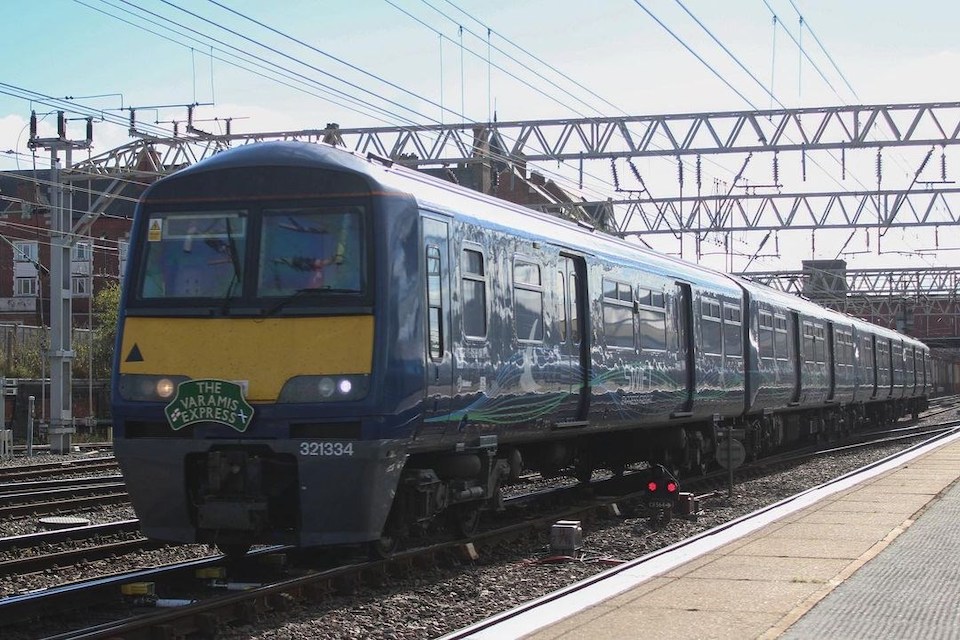
Joking apart, this whole energy pricing issue matters for the wider government ambition to grow rail freight by 75% by 2050. If small and medium-sized businesses are to be encouraged to try rail—through “less than train load” services or intermodal hubs, they need confidence that the operational economics are predictable. Flexible, low-emission services like the Daventry–Coatbridge train, which can remove 30 HGVs from the road, are exactly the kind of offer that will make modal shift feasible.
Current situation can turn into advantage
The real story, then, isn’t simply the headline cost of electricity; it’s the resilience of rail’s business model. Modern locomotives, growing numbers of purpose-built intermodal terminals, and carefully managed supply contracts combine to keep rail competitive. For operators willing to think beyond the short-term energy market, electrification remains an advantage, not a vulnerability.
Rail does feel the impact of electricity costs, but the effect is moderated by contracting strategies, operational flexibility, and higher energy efficiency compared with road haulage and much of heavy industry.
In the end, rail freight’s low-carbon credentials and operational flexibility are precisely why this sector should remain at the heart of Britain’s industrial strategy (assuming we have one). The electricity market may wobble, but the rails themselves keep delivering. That is a lesson both the industry and policymakers would do well to remember.