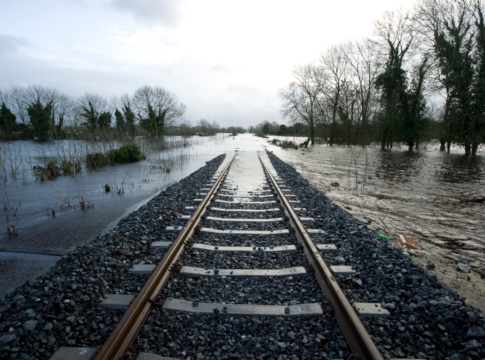
A new report published yesterday (Wednesday 18 June) underscores the need to adapt transport networks to withstand escalating climate risks and shows how this investment will yield significant economic returns.
Titled Transport resilience in a changing climate – The case for investment, the report outlines how targeted, forward-thinking investment can safeguard infrastructure, reduce long-term costs, and deliver more reliable, equitable transport systems in the face of climate change.
The product of a collaboration between London Transport Museum, global engineering firm Arup, international law firm Gowling WLG, and Hitachi Rail, the report has been published as part of the Museum’s thought leadership programme, Interchange. It offers practical strategies to help the sector adapt to climate risks, using examples from the UK and around the world. These include innovations like sustainable drainage systems and tools such as NatureInsight®, which uses data to design effective nature-based solutions.
Transport is on the front line of the climate crisis. Floods, heatwaves, and extreme weather events are no longer future threats; they are already disrupting services and endangering lives. For example, in 2024 Storm Bert caused up to £350 million in insured losses, disrupted trains for 90,000 passengers at London Paddington, and left 350,000 homes without power. Subsequent repairs to rail lines and roads took weeks, showing how vulnerable the system is. By 2070, the UK is expected to see 39% more winter rainfall and intense autumn storms.
Moreover, the World Meteorological Org (WMO) has warned there is an 80% chance that one of the next five years will be the hottest on record, and a 70% chance that the five-year average from 2025–2029 will exceed 1.5°C above pre-industrial levels. These changes pose serious threats to transport infrastructure.
The report tackles the core barriers holding back progress: disconnected goals and fragmented decision-making; a lack of shared tools and data; short-term planning cycles and outdated assumptions; gaps in funding models; and risk frameworks.
To address these, the report set outs five key actions to be taken:
- Establish common goals: develop specific, measurable, achievable, relevant, and time-bound (SMART) goals.
- Implement resource and finance effectively: expand green bonds and public-private partnerships to address funding gaps.
- Inform decisions through data and innovation: use AI and tools like Arup and Scalgo’s NatureInsight® to prioritise nature-based solutions, such as sustainable drainage systems. Ensure this data is democratised and accessible across different organisations.
- Build cross-sector collaboration: foster cross-sector partnerships, learning from initiatives like London’s Marylebone Flyover Rain Gardens.
- Adopt a resilience mindset: highlight economic and social benefits, such as job creation, as well as environmental necessity.
Investing in resilience offers far-reaching benefits:
- Economic: protects jobs, avoids costly repairs, and attracts sustainable investment.
- Social: ensures access to essential services during disruptions.
- Environmental: nature-based solutions can reduce emissions while enhancing urban ecosystems.
The report urges stakeholders to:
- Governments: mandate resilience standards and allocate long-term funding
- Businesses: prioritise adaptive infrastructure and partner with communities
- Local Authorities: engage local residents in co-designing solutions
Elizabeth McKay, director and CEO of London Transport Museum said: ‘From buckled rails to flooded tunnels, climate change is rewriting the rules for transport. This report isn’t just a warning; it’s a roadmap for reinvention. By learning from case studies, we see collaboration is our greatest asset, allowing us to build systems that don’t just survive but thrive in a world threatened by climate change.’
The Transport resilience in a changing climate report challenges policymakers, industry leaders, and communities to shift mindsets and reframe resilience as an economic opportunity – one that creates jobs, safeguards livelihoods, and ensures reliable transport for future generations.
Image credit: iStockphoto.com