Tensions are on the rise in Europe. Governments meet in fortified rooms to discuss potentially explosive situations. Military forces are put on alert. The UK has always relied on a swift deployment of limited resources, which has always meant bringing the logistic strength of the railways to bear on any situation. What legacy of railway mobilisation exists today?
Britain’s defence capabilities are under scrutiny like never before. While the size and availability of personnel and equipment may be a cause for concern, its ability to reply has never been in doubt. Until now. If called upon, could the UK armed forces depend on its peacetime ally – Britain’s railway network?
Rail as a weapon
Readers familiar with history books, especially twentieth-century volumes, may be concerned at the eager calls to beat plough shears into swords. The more contemporary analogy of game consoles into war game controllers may be more apt, on the belief that any future war in Europe will be a stand off affair, fought remotely.

However, military commanders are well aware that “boots on the ground” are the only way to consolidate a battlefield advantage. So, in this 200th anniversary year of the railways, they know that men and machines will need moving. For that, rail has been the weapon of choice for the past two centuries. In Britain, that has meant commandeering, at the double, railway assets to get troops into the fray.
Operator remains discrete
Britain’s Ministry of Defence has told RailFreight.com that the railways continue to play a significant role in military planning. “Movement of all MOD material by rail is conducted in accordance with national and international legislation,” confirmed a spokesperson for the Ministry. However, the routine movement of equipment happens all the time, under the anonymity of containerised traffic. Those movements involve a global logistics partner and one of the best-known names in British rail freight.
Very occasionally, regimental moves are conducted en masse by daylight trains. For example, regiments based in remote parts of Scotland can be seen heading for Salisbury Plain, Britain’s biggest training ground. Movements of battle machinery are not easy to conceal. A Challenger tank will not fit into a shipping container, not even a high cube one. It may be apparent to anyone happening to see such a movement, as to who is the contracted operator, but that is not a matter the operator makes public. In a briefing for RailFreight.com, that operator cited reasons of corporate confidentiality.
Paths for military specials
There can be no doubt that Britain has a war plan that involves the railways. Twice in the twentieth century, a declaration of war was swiftly followed by the shrill whistle of a railway locomotive. Within hours, resources were on their way from military bases to forward rally points and embarkation ports. What might that mobilisation look like in the present day?
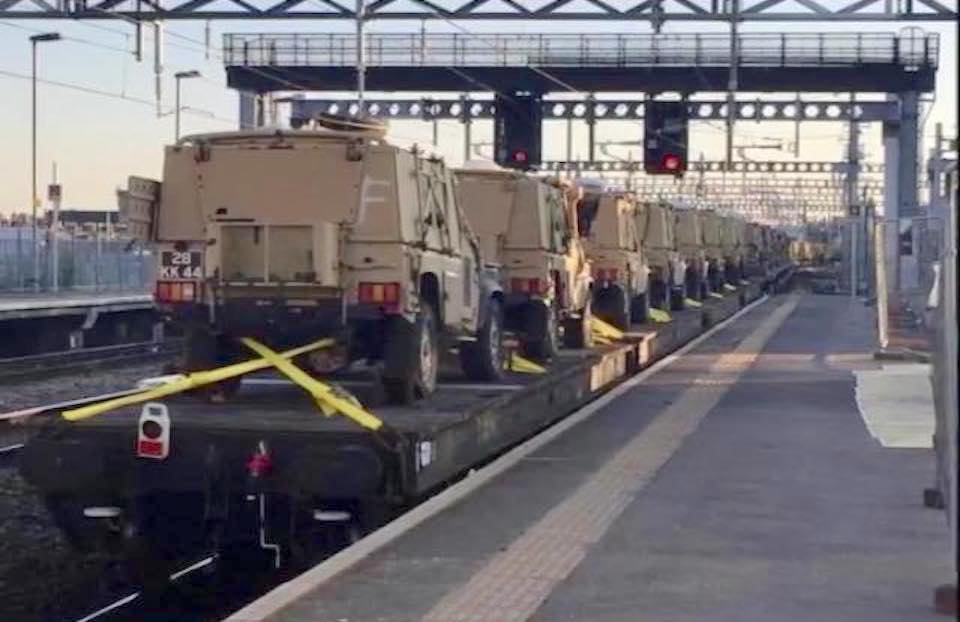
The answer is it will happen, with just as much haste and military precision. However, it may not be quite as visible to the travelling public. Passengers may find some trains commandeered at short notice to move an entire regiment. Some other trains may be cancelled to provide paths for military specials. However, significant parts of Britain’s armed forces are already on overseas deployment, providing an immediate response if required.
Reliance on rapid mobilisation
Historically, Britain has never had a large standing army when compared to European neighbours – friendly or otherwise. Since Britain stopped seriously falling out with the French, the British Army has been small, with a heavy reliance on the rapid mobilisation of reserves and conscripts. That’s unlikely to be the case in any future conflict. The sophisticated level of military professions requires any conflict to be fought with the resources already at hand.

To that end, the Ministry told RailFreight.com that it already has robust logistics provision in place, and that includes partners from the rail freight sector. “Team Leidos is the MOD’s delivery partner through the Logistics, Commodities & Services Transformation contract,” said a spokesperson. That contract has been in place for ten years.
Exercises and where to see them
The involvement of Leidos is no secret. Leidos was awarded its MOD contract in 2015 and has taken part in exercises ever since. “It is precisely for activities like these that Team Leidos, as the UK’s Defence Delivery Partner, has embedded an operations team in DSCOM [Defence Support Chain Operations and Movements] to enhance the delivery of military effect,” said Mark Rowlands, their operations head, after one such large scale operation involving deployment to mainland Europe. “We worked closely with our DSCOM colleagues to plan in detail how we would deliver a successful outcome and to provide daily progress updates throughout the execution phase.”
Military convoys are common on Britain’s roads – if you know where to look (hint: around larger barracks and places with those unusual hazard warning triangles with a tank silhouette are a good place to start). As already noted, military trains are occasionally seen on Britain’s network – the only warning may be an announcement to stand back from the platform edge. The Ministry of Defence did, however confirm that the defence logistics contract does include the provision of rail services. A spokesperson did confidentially name both the logistics contractor (a globally recognised company) and their British rail freight partner. “The contract includes the provision of rail services by its sub-prime contractor for [Ministry of] Defence rail moves on the UK’s main lines,” they stated.
The size of Britain’s armed forces may be a topic of debate. It would appear that their ability to deploy is in safe hands. A red light for action will be met with a green light down the tracks.