The proposed £1.5 billion (€1.76bn) Oxfordshire Strategic Rail Freight Interchange (OxSRFI) has entered the formal examination process. However, despite national ambitions to increase rail freight, local opposition is highlighting the environmental impact of a development intended to encourage freight from road to rail. The concerns are primarily around the scale of the associated warehousing.
The scheme near Ardley, south-west of Junction 10 of the M40 highway, includes a rail terminal connected to the Chiltern Main Line. At issue is the proposed 603,850 square metres of logistics space. Campaigners argue that the scale of the associated warehousing and highway infrastructure risks creating substantial additional road traffic and environmental damage. Rail appears to be caught in the crossfire – again.
Rail freight policy meets local concerns
The Planning Inspectorate’s examination began on 29 September, when a preliminary meeting and hearing considered the principle and scope of the proposed development, its need and alternatives. A second hearing on 30 September considered environmental matters and the draft Development Consent Order.
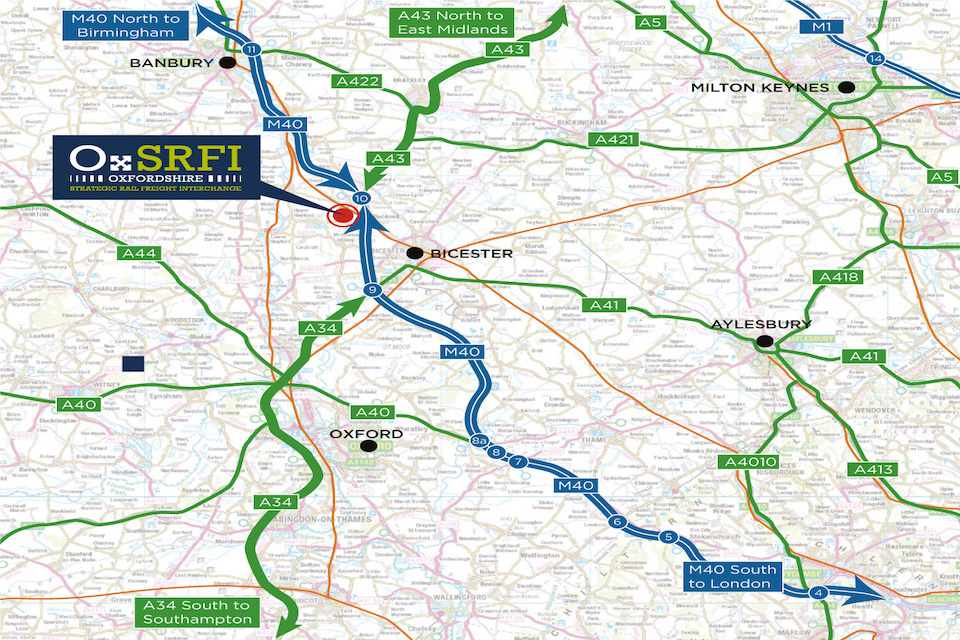
Oxfordshire Railfreight Limited, the special-purpose vehicle promoting the project, argues that OxSRFI responds to government policy encouraging a network of strategic rail freight interchanges. The Government’s National Networks National Policy Statement identifies the need for strategic rail freight interchanges as part of nationally significant infrastructure. The developer says the scheme will support a shift from road to rail while contributing to economic growth in the Oxford-Cambridge Growth Corridor. Mountpark, which would develop the site, estimates that the project could create more than 9,000 jobs and contribute £361.2 million annually to the national economy.
Scale of development under scrutiny
The proposed interchange is considerably more than a rail terminal. As reported previously by RailFreight.com, logistics development runs alongside the railway infrastructure plans. The application includes up to 603,850 square metres of distribution and logistics floorspace, equivalent to around 6.5 million square feet, plus associated mezzanine space. The highway element is also substantial. Proposed works include improvements around M40 Junctions 9 and 10, an Ardley Bypass, the Heyford Park Link Road and Middleton Stoney Relief Road. The application also includes changes to the Ardley Tunnel to provide the required rail gauge.

That scale has become a central issue for opponents. The Oxfordshire branch of the influential Campaign to Protect Rural England (CPRE) has argued that, while it supports the principle of rail freight, the particular development risks becoming primarily a large warehousing and road-development project. Campaigners have also questioned whether the environmental costs and loss of agricultural land can be justified by the proposed modal shift.
Testing the case for rail
Cherwell District Council, the local administration, which is autonomous from the larger Oxfordshire County Council, has not opposed the OxSRFI project outright, but has registered as an Interested Party in the examination. Its response raises issues including ecological mitigation, protected species, biodiversity net gain, landscape effects and the historic character of the surrounding area.
The debate goes beyond whether rail freight itself is environmentally beneficial. The question is whether the wider development required to create this interchange delivers sufficient rail benefits to justify its overall environmental and transport impacts. The council has also sought further evidence on the viability of the intermodal terminal, including the availability of rail freight paths and the technical requirements for rail access. These issues will now be considered as part of the formal examination rather than through the normal local planning process.
The controversy neatly illustrates a wider challenge for rail freight development in Britain. Strategic rail freight interchanges are intended to move more goods by rail and reduce dependence on road transport, but they require large sites, distribution warehouses, road connections and substantial supporting infrastructure. That is not often an outcome that local administrations are eager to rubber stamp. The Planning Inspectorate now has six months to examine the application before making a recommendation to the Secretary of State for Transport. A decision on the £1.5 billion project is therefore not expected until 2027. OxSRFI has a long way to go before seeing a green signal.