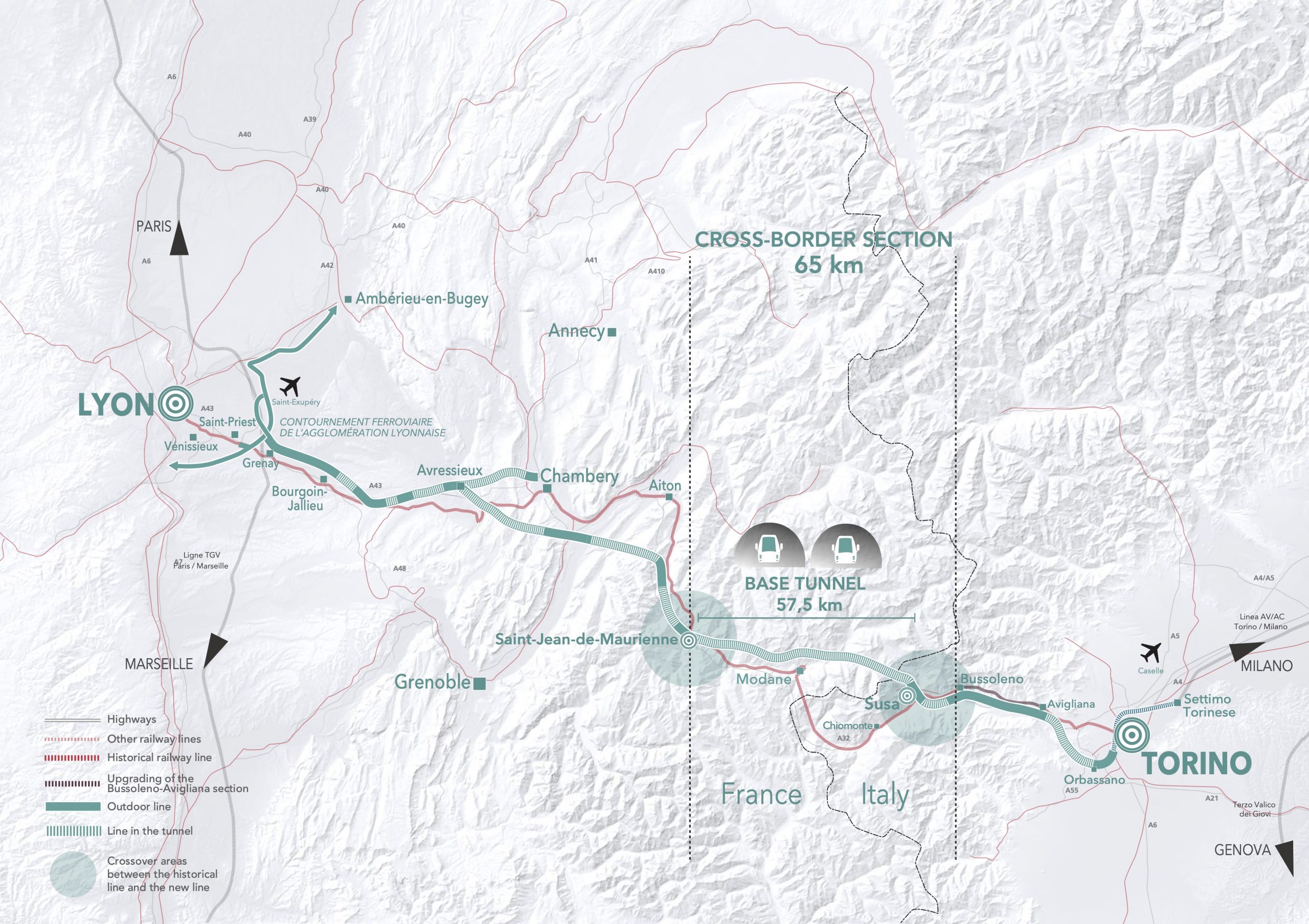
The European Commission (EC) adopted a new implementing decision regarding the Turin-Lyon project, a key cross-border rail project along the TEN-T Mediterranean Corridor. “As a result of this act, for the first time all sections of the project—including the national sections (…), not just the cross-border section—are eligible for European Union funding”, said TELT, the company overseeing the project.
The EC’s decision also outlines a timetable for all the sub-projects, including the access lines to the tunnel from both sides, which should see completion around 2033. The first initiative is the start of mechanised excavation of the first French lot of the base tunnel, planned for this year, while the last one will be the deployment of ERTMS Level 2 along the whole line in 2033.
The French and Italian national projects
For the Italian side, the next planned actions are the upgrade of the Bussoleno–Avigliana and Avigliana–Orbassano lines, which connects the city of Turin to the Italian entrance of the tunnel. Concerning rail freight, the main project regards the Orbassano marshalling yard, a key logistics hub in the area.
The projects on the French side include the upgrade of the rail freight line passing through Avressieux, Ambérieu and Saint-Jean-de-Maurienne, where the French entrance of the tunnel will be located. Moreover, there is the construction of the Lyon railway bypass between Saint-Pierre-de-Chandieu and Dagneux, running east of the city.
A much needed infrastructure
Improving cross-alpine rail infrastructure is a vital need for the rail freight infrastructure, especially between France and Italy, where the infrastructure is significantly outdated. The main historical line has been subject to an increasing number of disruptions due to climate change, for example. The link was closed for 19 months between August 2023 and April 2025 due to a landslide, leading to catastrophic consequences especially for the Italian industry.
The new infrastructure should guarantee higher safety since it will be much newer and thus up to more modern standards. Moreover, it should also provide better protection against extreme weather conditions, as the current mountainous line will be replaced by an underground tunnel. A Base Tunnel such as the one planned in the Turin-Lyon will also require less power to haul freight trains, as the steeping gradient is much lower than the current section.